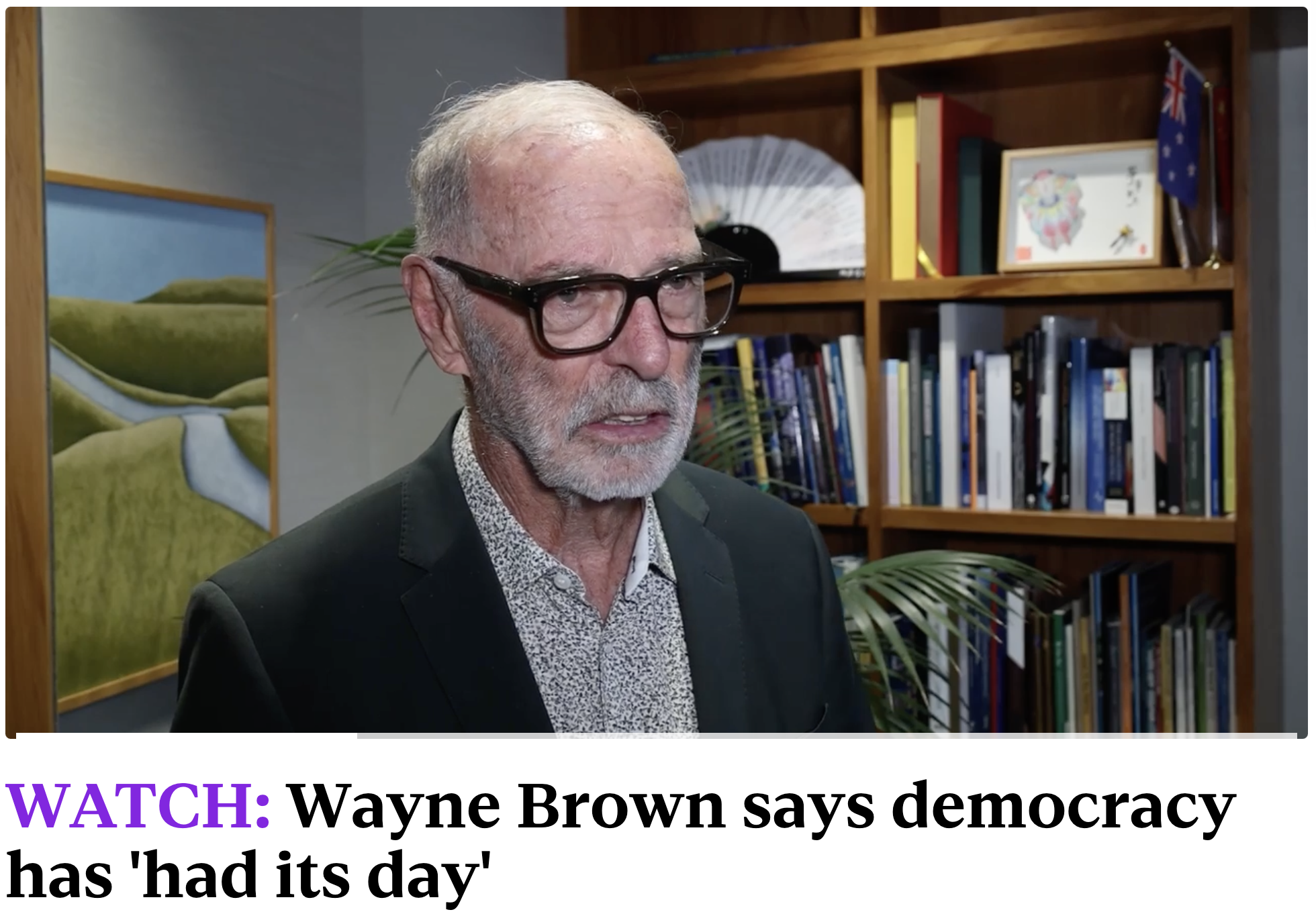
Auckland Mayor Wayne Brown has returned from China with an extraordinary revelation: apparently, democracy has had its day.
The democratically elected Mayor of Auckland has decided that the very system that put him in office might have outlived its usefulness.
After a visit to China, Brown criticised New Zealand's democratic decision-making and questioned whether our MMP system was working.
There's plenty to criticise about MMP. There's plenty to criticise about our politicians, our Parliament, and the often painfully slow machinery of government.
But there's a significant difference between criticising how democracy works and suggesting that democracy itself has had its day. And there's an even bigger difference between admiring China's economic development and overlooking the authoritarian regime that governs it.
Someone needs to remind the Mayor that the freedoms he enjoys here in New Zealand don't exist in the same way in China.
In New Zealand, Wayne Brown can criticise the Government, attack its policies, challenge its decisions, and campaign to replace it. He can speak his mind without needing permission from the ruling party.
In China, citizens who openly challenge the Chinese Communist Party can face censorship, surveillance, detention, and imprisonment.
That's not some minor inconvenience of an otherwise efficient political system. It's the fundamental difference between a free society and an authoritarian one.
While Brown has clarified he isn't advocating that New Zealand adopt China's communist system, his comments still reveal a troubling willingness to dismiss the value of democratic accountability. There's an even bigger problem.
Brown's comments come at a time when New Zealand's intelligence services are repeatedly warning about foreign interference.
The NZSIS's 2026 Security Threat Environment Report identifies the People's Republic of China as the most active foreign state conducting interference in New Zealand and the only country detected conducting espionage here at scale.
The report also warns that politicians, candidates, and politically influential people are targets of foreign interference. Our intelligence services warn that the Chinese state is actively attempting to interfere in our democracy, while the Mayor of our largest city is publicly questioning whether democracy has run its course after a visit to China.
Foreign interference thrives when democratic institutions are weak, transparency is lacking, and those entrusted with public office become complacent about the freedoms they're supposed to protect.
This is exactly why PILLAR has been pushing for greater transparency around foreign political influence. Our Foreign Influence Transparency Bill would require political influence activities directed by foreign principals to be publicly disclosed through a registration framework.
New Zealand remains the only Five Eyes country without a foreign agents registration scheme. With intelligence warnings becoming increasingly serious, it's time our political leaders treated this issue with the urgency it deserves.
Democracy is frustrating. That's the point. It isn't supposed to make life easy for politicians. It's meant to hold politicians accountable to the people. It's meant to allow ordinary New Zealanders to question authority, challenge decisions, organise opposition, and remove leaders who have lost their confidence.
Of course, democratic systems are imperfect. They can be inefficient, bureaucratic, and slow. But the alternative isn't a magical system where everything gets done faster and everyone lives happily ever after. The alternative is concentrating power in the hands of people who no longer have to answer to those they govern.
History has given us plenty of examples of where that leads.
Wayne Brown is perfectly entitled to criticise MMP. He's entitled to admire China's infrastructure and economic development. But he should be a little more careful about dismissing the democratic freedoms that allow him to say those things in the first place.
Democracy hasn't had its day, Mayor Brown. It's the reason you're allowed to have yours.