
Protecting Children Starts with Parents
The campaign to ban social media is built on a narrative of parental fear and desperation, a grand story of oppression from Big Tech and little Johnny in the shackles that Mark Zuckerberg made for him. This is a convenient story to tell New Zealanders when politicians want to build a state operated internet regulator with what will likely be extensive censorship powers – we've seen this play out in Europe and the UK already.
The stories being told to justify these policies don’t often have to be true – just convenient to the agenda. Take for example the irony of a picture that Erica Stanford posted this week with year 13 students from affluent looking high schools talking to her about the harms they’d experienced on the internet and the need for change; never mind the fact that all the students looked very well put together, seemed to have achieved very highly in their schools, in academics and extra-curricular activities (despite the disastrous harms of social media!)
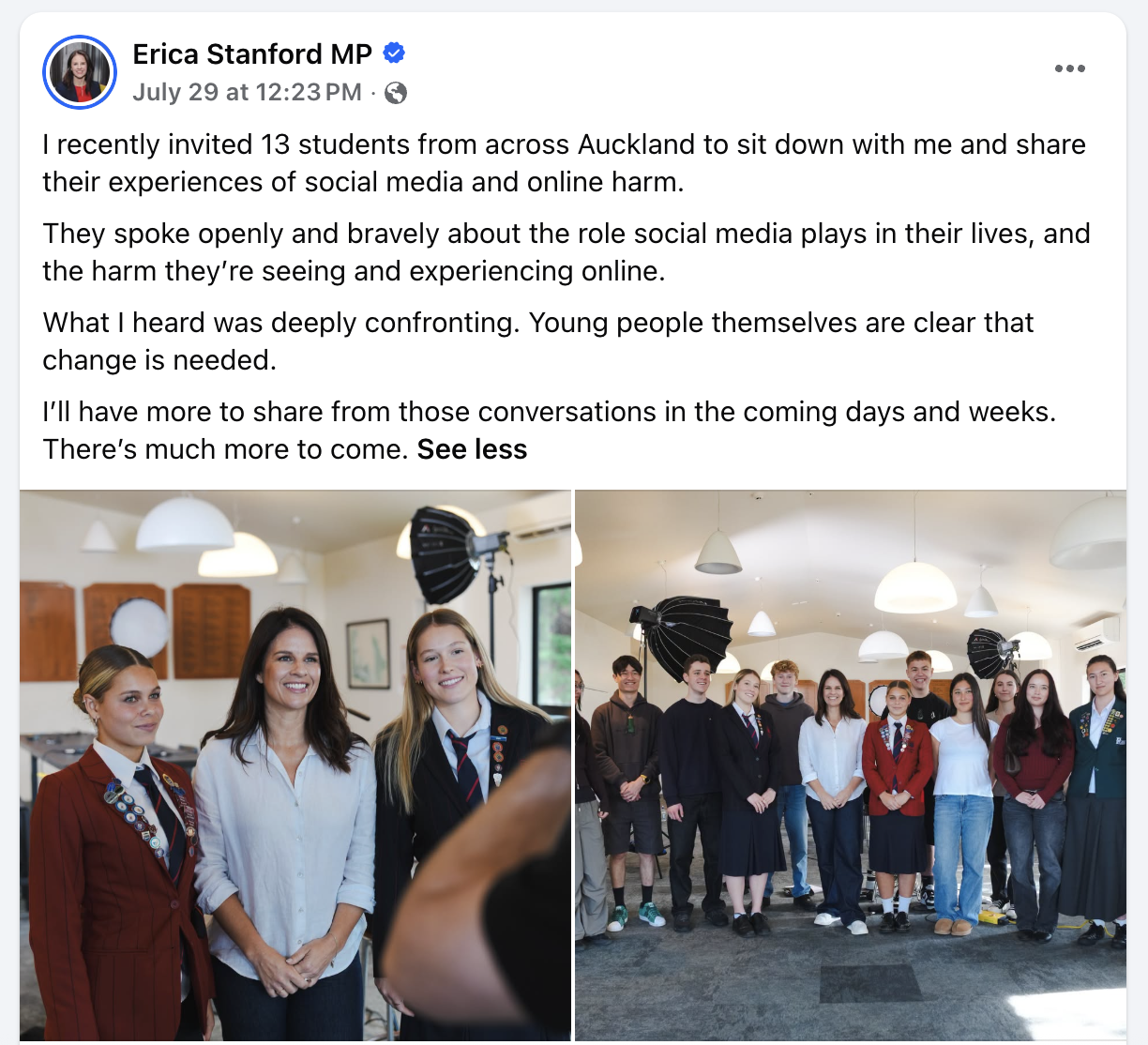
This is an example of convenient storytelling that justifies an increasingly unpopular policy – the story did not have to be too true or coherent; it just had to paint a picture.
The stats, however, paint another, more realistic and angst inducing picture. A picture that does not create moral panic. A study released by the Australian eSafety Commission last week landed on principle we’ve been talking about for months: Parents are the best defence against online harms.
The study surveyed 2,008 parents of children aged 3 to 10 and paints a very different picture of what actually keeps children safe online, finding that:
92% of parents have rules in place to help their children stay safe online.
84% regularly provide guidance and advice about online safety.
68% actively monitor their children’s online activity.
71% use parental control technologies.
Around 93% regularly discuss online safety with their children.
The report also found that parents often underestimate the emotional support children receive online, highlighting the need for better education and stronger communication rather than blanket prohibitions.
It feels that the tune has changed a little. Instead of the grandiose promises of a social media ban (which has now, in effect, failed in Australia), they are now speaking about the critical role of parents.
Where was this emphasis before the online regulatory systems were set up?
As part of this year’s budget, the New Zealand Government has pledged to spend over $30 million on a project that looks to increase ‘online safety’ for children.
When the data shows that these measures are futile attempts which only create privacy and mass surveillance risks, why continue to pursue them? If the numbers are anything to go by, we ought to commend, encourage, educate and empower parents even more and stop seeking alternatives that simply fail.
The reality is that we cannot outsource parenting to Wellington. The role of government should be to equip parents, not replace them.
A free society is a responsible society, and parents are an essential cornerstone that we cannot reject.
PILLAR will continue to sound the alarm and build the case for freedom - thank you for standing with us.