Trying While Dying Slowly…
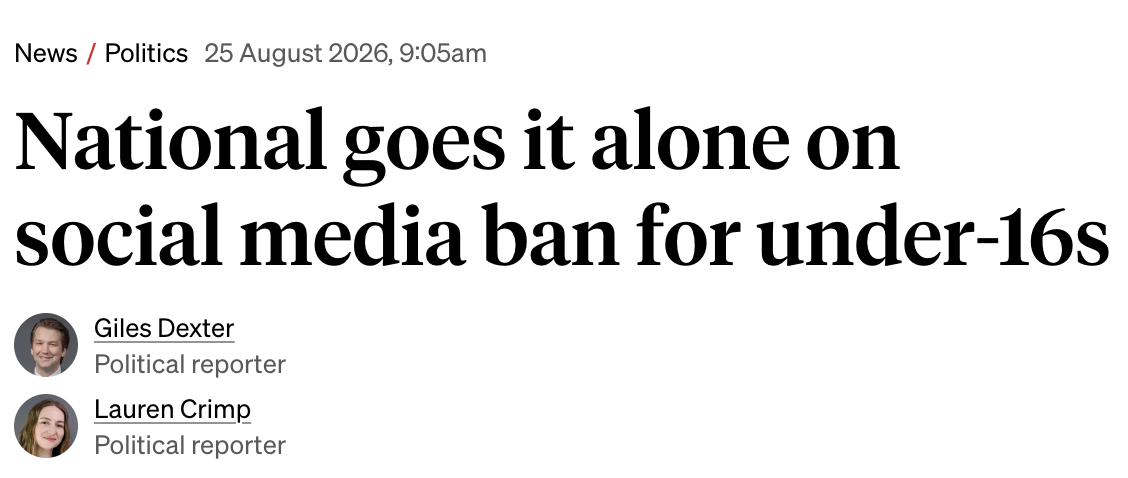
It’s official. National has doubled down, making yet another bad decision in the lead-up to the election, this time to ban social media for under 16s.
I’m tired of the virtue signalling and false intellectual posturing that has dominated this conversation. “But isn’t social media bad for children?” Of course there is potential harm online. Nobody serious is denying that.
There are predators. There is pornography. There is bullying, exploitation, addictive content and algorithms designed to keep kids scrolling. We know. But simply repeating “think of the children” doesn’t make bad policy good policy. Acknowledging the harm is not the end of the conversation. It’s the beginning.
The real questions are harder. Who is responsible for protecting children? What solutions will actually work? And how much power are we willing to hand the Government over the internet in the process? Because here is the part that keeps getting ignored.
You cannot build an under-16 social media ban without building a system to work out who is under 16. That means the rest of us get caught in the net too.
We now we know what National is proposing. An online regulator. Age verification. Facial age estimation. Digital ID. Formal identification.
This is no longer some hypothetical warning about where online regulation could lead.They are building the infrastructure.
When I was 14, my dad handed me his brand-new iPhone 4. A Vodafone rep had convinced him it was a worthy upgrade from his trusty Nokia brick. He hated it. So within days, it was mine. I was 14 years old with a smartphone and absolutely no idea how to conduct myself online.
Within weeks I had racked up charges on Dad’s credit card buying songs and embarrassed my parents with a risky Facebook status that upset a church member who, I might add, was often offended. Both times I got pulled up. Access restricted. Privileges revoked. Problem addressed.
I didn’t need a law. I needed parents.
The internet has changed since then. Social media isn't a Facebook wall where your aunt posts blurry photos from Christmas. It’s sophisticated, addictive and capable of exposing children to things no parent wants their child seeing.
The problem is real. But the principle remains.
Parents, not the Government, are primarily responsible for raising their children.
Government has a role. It should go after predators. It should prosecute exploitation. It should target grooming. It should help stop abusive material spreading online. It should give parents better tools.
What it should not do is use the existence of harm as justification for building the infrastructure to regulate everyone's access to the internet.
Here’s the problem nobody can escape: If social media is illegal for someone under 16, how does Instagram know you're 16?
How does TikTok know? How does YouTube know? How does the next platform know?
Someone has to check. That is the problem at the heart of this entire scheme. There are basically three options.
Make age verification weak enough that teenagers can get around it. Make it annoying enough that every adult is constantly proving their age. Or make it invasive enough that platforms can reliably establish who you are. That is the trap. And we've already watched governments overseas walk straight into it.
When restrictions don't work, they don't say, “Well, that was a bad idea.”
They expand them. More platforms. More verification. More enforcement. More power for the regulator.
Today the argument is about 15-year-olds using TikTok.
But once the machinery exists, what comes next?
At what point does proving your age become proving your identity? And at what point does the digital bouncer at the door of social media become the digital bouncer at the door of the internet?
Build the infrastructure and future governments inherit the keys. That should concern you regardless of who you vote for.
So what would we do instead? For more than a year we have been working on an alternative.
The Digital Bill of Rights Act. DBORA.
Our starting point is simple:
Protect children without treating every New Zealander like a child. Put parents back in control. Educate parents around parental controls at the device level, where Mum and Dad can decide what their children can access. Teach digital resilience in schools and give parents practical education to help them navigate a technological world that is changing faster than any of us can keep up with. Hammer clearly illegal activity. Target predators, grooming, exploitation and abusive material.
And where age assurance is genuinely justified, particularly for adult-only material, target it there. Don't build an identity checkpoint around ordinary participation on the internet. There is a massive difference between those two approaches.
National asks:
How do we stop under 16s accessing social media?
We ask:
How do we make children safer online while protecting everyone else's freedom?
I think that is the question New Zealand should be answering. Good intentions aren't enough.
I don't doubt that many of the people supporting this genuinely care about children. So do we. That's not the disagreement. The disagreement is over what happens next. You don't get to say “protect the children” and then wave away every concern about privacy, free expression, digital ID, regulatory power and government overreach.
Those questions matter too. The Bill of Rights matters. Privacy matters. Freedom of expression matters. Parental responsibility matters. And precedent matters.
Because governments change. Ministers change. Definitions change. Regulators expand. Technology changes. Infrastructure remains.
We can protect children without building a digital checkpoint around the internet. We can empower parents. We can educate kids. We can target predators. We can force technology companies to give families better tools. We can aggressively pursue actual illegal harm. And we can do all of that without requiring ordinary New Zealanders to prove who they are before participating in ordinary online life.
National may have identified a real problem.
But they have chosen the wrong solution.
And we intend to fight for a better one.