Mouldy school lunches?
Who’s feeding our children?
Friend, have you seen report after report about mouldy food allegedly given to students through the Government’s school lunches programme?
In case you missed it:
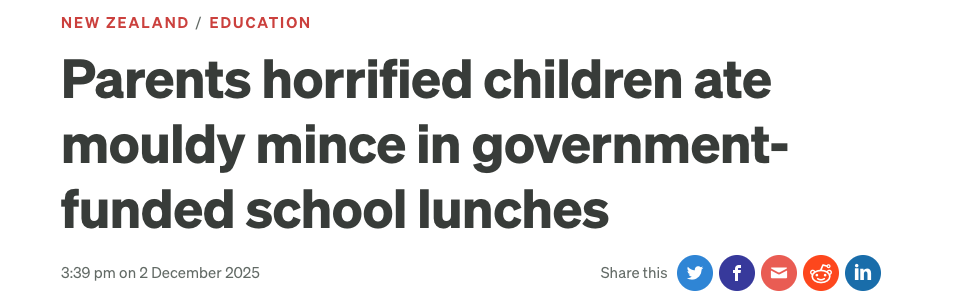
A Christchurch school, Haeata Community Campus, served mouldy and spoiled lunches to students after failing to refrigerate the meals when they arrived. The food, delivered days earlier, was left unrefrigerated at the school and was later mistakenly served alongside fresh lunches. Some students ate the rancid meals before the issue was caught, leading the school to issue a food-poisoning warning to parents. An investigation is now underway into the school’s handling and storage of the food.
Now, put aside for a moment two years of media frenzy concerning school lunches, criticisms of the relevant minister’s handling of the situation, the clear bias in much of the reporting, and the notable frequency with which the school principal in this instance seems to go to the media with criticisms of the Coalition Government.
Rather, let’s look at this more broadly, Friend, and consider how we’ve reached a point where we assume the state should be responsible for feeding our kids at school.
You don’t have to be a genius to realise that the size and scope of the Government's responsibilities will inevitably expand when we, the people, fail to take responsibility for our own lives and families. If we haven't prepared the meal ourselves, we can now assume someone else will.
A nation of people that won’t teach or feed their own children, won’t take responsibility for the social, economic, and psychological welfare of their families, will lose its capacity to make wise political choices.
This then enables elected officials and bureaucrats the opportunity to assume greater control.
Of course, if enough voters want the state to provide lunches in schools, voting as such is their democratic right. Nor can we pretend that the problem of kids going hungry in schools isn't a very serious one. It's an obvious fact that hungry kids struggle to learn and attendance rates can be impacted.
But anyone who wants to decry growing Government influence over the daily actions of life and what the public education system is teaching (and feeding) their child should first, and foremost, consider whether they and their household have borne the responsibility necessary to keep the creeping state out.
A society like ours, with the memory of a recent past where Kiwis did a far better job of feeding their kids, may want to now choose the path of least resistance: accepting the offer of school lunches from an enthusiastic state. But it fails to address the increasing trend of abdication of responsibility on the part of parents.
We are entitled to exercise our freedoms in various ways. Inevitably, there will always be some of us who don't pull our weight. But a culture of freedom is nurtured when the vast majority of citizens consistently honour their responsibilities. Inviting government to assume the lion's share of that duty creates a culture of dependence that becomes hard to shake.
The answer to most of the woes we face in our nation is not a more powerful state with more tentacles stretching into more aspects of our lives. Rather, the answer is more often a respect for the freedom of others and the personal responsibility which such a culture entails.
Where we see difficulty and strife in our land, the cause is rarely too little government - it’s actually too little of us: individuals, you, me, parents, churches, charities, and communities.
Of course, there is a real and genuine place for government to play its role in a free and democratic society. But let's not settle for easy short term state solutions which ignore properly effective long term solutions.
PILLAR’s mission is simple, to contribute to a culture that cherishes freedom, a system that prioritises liberty, and people who recognise the innate value and dignity in one another.
Achieving this requires keeping the state out of things we as citizens can competently manage ourselves.
This is why subsidiarity is so important to protect. As a columnist recently put it, it is a “crucial feature of any healthy democracy. The concept of subsidiarity means decisions should be made by the smallest, most local, most competent unit possible: families first, communities next, local government after that, and only then the central state.”
Friend, will you be the local bearer of responsibility where you are? You, Subscriber First Name, have so much to contribute and add to the lives of those around you (even if it's simply washing the dishes at home, or making mould-less lunch for your kids!), don't surrender this to state because it will be just the start.